MIZE
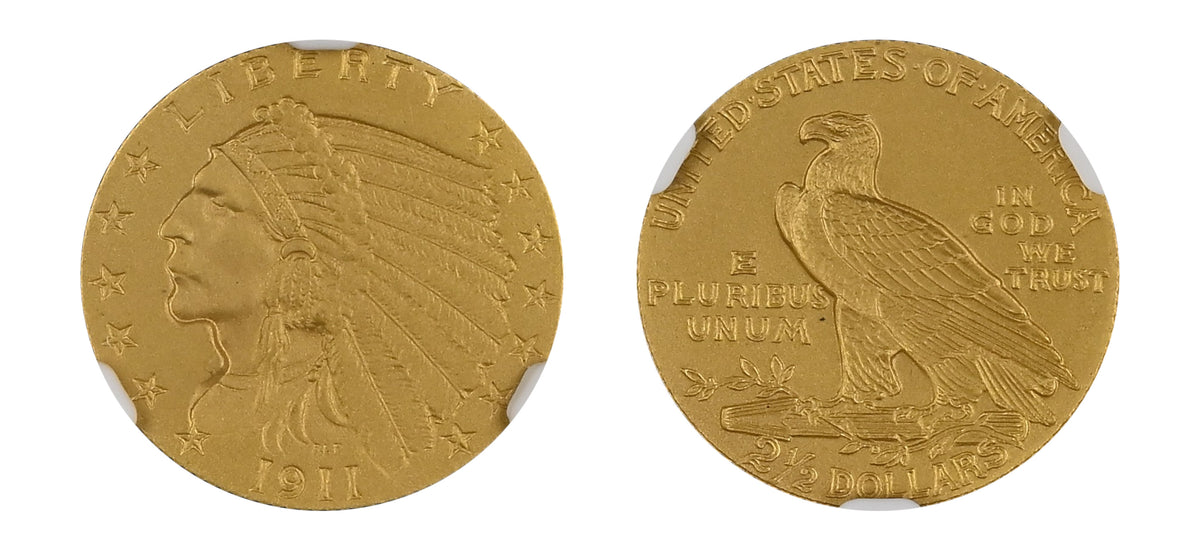
1911 $2.50 Indian Head NGC PF67+
1911 $2.50 Indian Head NGC PF67+
Couldn't load pickup availability
The 1911 Indian Head $2.50 gold quarter eagle comes from an era of innovation in U.S. coin design. Bela Lyon Pratt's incuse design – used on the $2.50 and $5 Indian Head gold pieces – was introduced in 1908 at the urging of President Theodore Roosevelt. Unlike traditional raised relief, the Indian's portrait and eagle are sunken below the coin's surface, a feature that was highly unusual and initially controversial (critics claimed the recessed areas might collect dirt or make the coins hard to stack).
Obverse: A left-facing Native American chief wearing a feathered war bonnet is surrounded by 13 stars and the word "LIBERTY" above, with the date “1911” below. The sunken engraving and matte surfaces exhibit flawless definition and uniformity.
Reverse: A stately eagle perches on a bundle of arrows and olive branches. “UNITED STATES OF AMERICA,” “E PLURIBUS UNUM,” “IN GOD WE TRUST,” and “2 1/2 DOLLARS” form a tightly inscribed perimeter. The incuse lettering and devices are crisply struck with pristine edges.
Overall, the 1911 Indian Head $2.50 proof is a product of its time – a coin with unique incuse artistry and a refined sandblast proof technique that make it a standout piece in U.S. numismatics. Its historical significance is underscored by being part of Roosevelt's Renaissance of American coinage and one of the last series of U.S. proof gold coins, which ended in 1915.
Share