MIZE
1909 $5 NGC PF66
1909 $5 NGC PF66
Couldn't load pickup availability
The 1909 Indian Head half eagle ($5 gold) comes from the era of America's early 20th-century coinage renaissance, a period driven by President Theodore Roosevelt's push to beautify U.S. coins. Designed by Boston sculptor Bela Lyon Pratt, the Indian Head $5 (along with its $2.5 quarter eagle counterpart) featured a revolutionary incuse design – the images and inscriptions are sunk below the coin's surface rather than raised. This sunken (incuse) relief technique was unprecedented in U.S. coinage and initially controversial; some contemporary critics even claimed the recessed areas might collect dirt and spread disease.
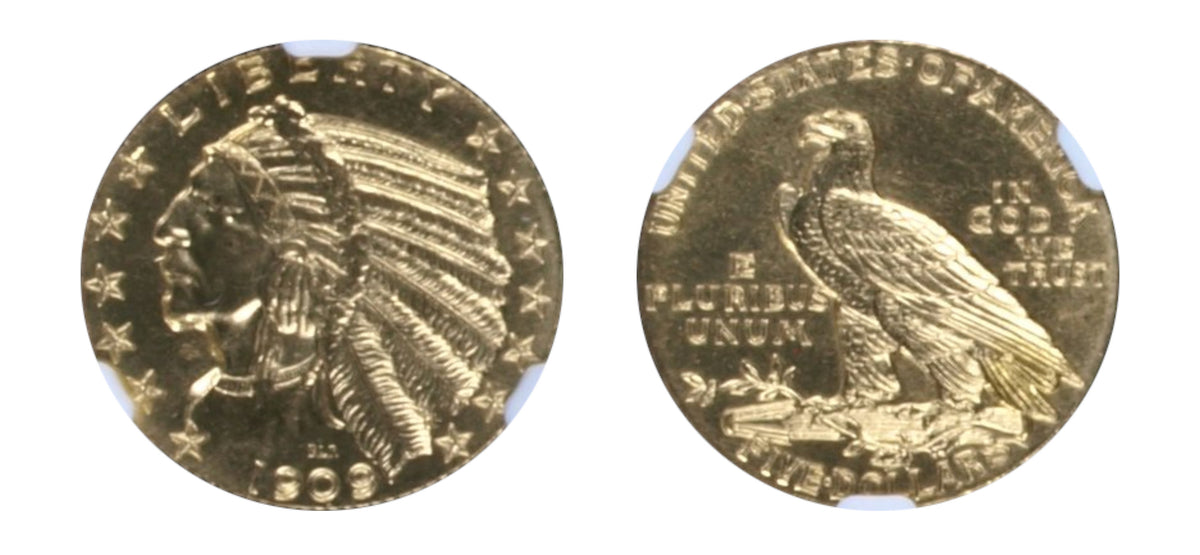
Obverse: Depicts a left-facing Native American chief in full feathered headdress surrounded by 13 stars with the word LIBERTY above and the date “1909” below. The portrait features bold incuse relief with minimal surface disruption, especially rare in PF66 condition.
Reverse: Features a perched eagle clutching arrows and an olive branch, symbolizing both military readiness and peace. Surrounding inscriptions include UNITED STATES OF AMERICA, E PLURIBUS UNUM, IN GOD WE TRUST, and the denomination FIVE DOLLARS. Like the obverse, the reverse fields exhibit a uniform satin texture typical of the Roman finish proofs.
The Roman finish proofs of 1909 have a brighter, semi-reflective yellow-gold surface – a "satiny" sheen that falls between a brilliant proof and the dull matte of other years. This satin texture beautifully accentuates Pratt's incuse design, as light shimmers off the recessed details in a unique way. After 1910, the Mint reverted to matte/sandblast proofs for 1911-1915. Thus, 1909's proof coinage stands out as the first of only two years to feature the distinctive Roman (satin) proof finish, making these proofs especially intriguing to collectors.
Share