MIZE
1680 Gold Guinea Charles II NGC XF40
1680 Gold Guinea Charles II NGC XF40
Couldn't load pickup availability
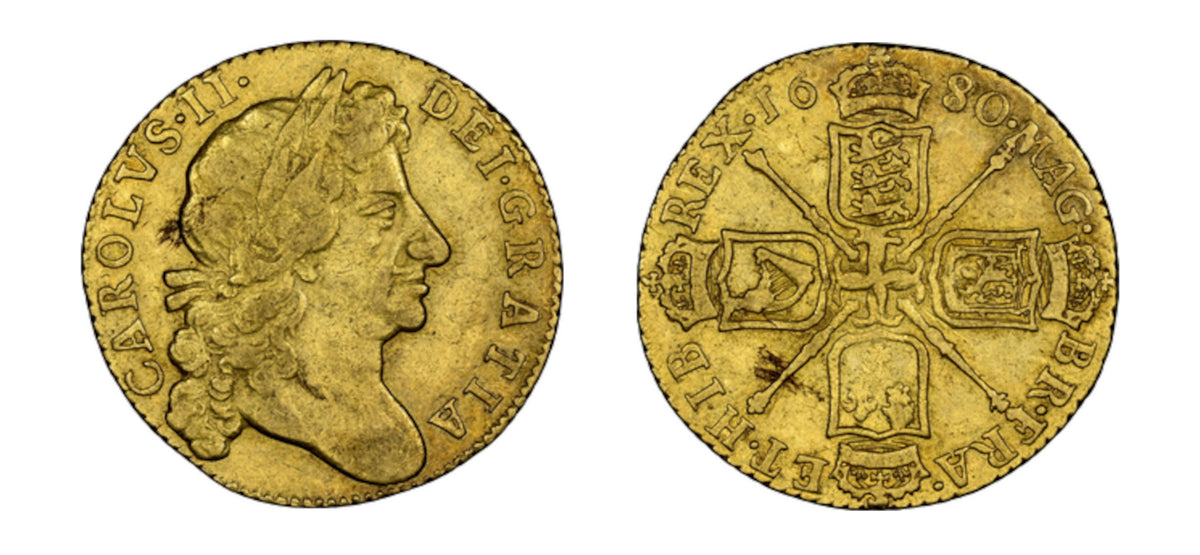
This 1680 gold guinea was struck during the reign of Charles II as part of the modernization of English coinage, transitioning from hammered to machine-milled coins. These were fully milled gold coins, struck at the Tower Mint in London with a reeded edge to deter clipping.
The coin takes its name from the Guinea region of West Africa, source of much of the gold. Some 1680 guineas feature a tiny Elephant & Castle motif beneath the king's bust, signifying the coin was struck from gold supplied by the Royal African Company. These Elephant & Castle marked coins are considered "extremely rare" and highly sought after by collectors
Obverse: Displays a laureate and armored bust of King Charles II facing right, with long flowing hair and high-relief detailing. The surrounding legend reads:
“CAROLVS·II·DEI·GRATIA” — Charles II, by the Grace of God.
Reverse: Features a cruciform arrangement of four crowned shields representing the arms of England, Scotland, Ireland, and France, with scepters in the angles and a small central cross. The inscription reads:
“MAG·BR·FRA·ET·HIB·REX·1680” — King of Great Britain, France, and Ireland, 1680.
Struck in .917 fine gold and weighing approximately 8.3 grams, this guinea is a product of England's first stable gold currency system, introduced during Charles II’s reign. The Fourth Bust type, used from 1678 to 1684, is widely regarded as the most aesthetically refined of the series.
Graded NGC XF40, this specimen retains strong device detail with modest even wear, attractive buttery-gold coloration, and full, legible legends. The strike is well-centered, and the coin’s eye appeal is further enhanced by its smooth, untouched fields. The presence of this piece in the Ellerby Hoard adds considerable historical and collector value, connecting it to one of the most important British gold hoard discoveries of the 21st century.
Share